


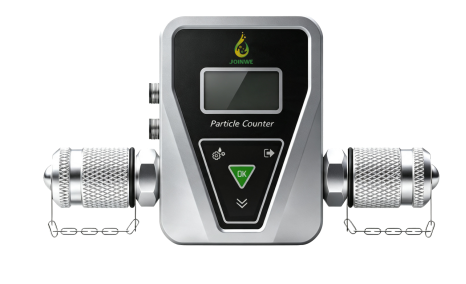
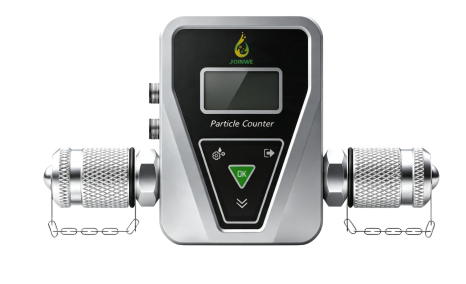
The JWJ5 Oil Particle Counter Sensor is designed for continuous online monitoring of solid particle contamination in hydraulic and lubrication oils. Based on the light blockage principle, it measures particle size and quantity and outputs oil cleanliness levels according to ISO 4406 and NAS 1638.
JWJ5 Online Oil Particle Counter Sensor with Adaptive Flow Compensation
Traditional online particle sensors require a constant oil flow of 25mL/min; their concentration calculation is calibrated based on this rated flow. For hydraulic and lubrication pipelines in steel mills, fluctuating oil pressure leads to unstable flow rates. The oil volume flowing through the sensing chamber changes, causing large errors in calculated particle concentration under the same total particle content.
Our sensor is equipped with dynamic adaptive flow compensation technology. It collects real-time actual oil flow speed and revises data via algorithm, free from flow variation interference to deliver stable and accurate concentration readings.
Unlike conventional online particle sensors that depend heavily on a fixed sampling flow, JWJ5 uses dynamic adaptive flow compensation to correct measurements when pipeline flow changes. This makes it particularly suitable for hydraulic and lubrication systems where operating pressure and oil flow fluctuate during production.
Why Choose JWJ5 for Online Oil Particle Monitoring?
Stable Measurement Under Changing Oil Flow
Traditional online particle counters are generally calibrated around a specified sampling flow. In actual hydraulic and lubrication systems, however, pressure and flow conditions may change continuously.
JWJ5 measures the actual oil flow through the sensing chamber and uses an adaptive algorithm to compensate for flow variations. This helps reduce measurement fluctuation caused by changing sampling conditions and provides more consistent particle contamination monitoring.
This feature is particularly useful for industrial hydraulic and lubrication systems with variable operating conditions.
Real-Time Oil Cleanliness Monitoring
Instead of relying only on periodic manual oil sampling, JWJ5 can be integrated into an online oil monitoring system for continuous or periodic particle contamination measurement.
Operators can use the particle data to:
- Track changes in oil cleanliness
- Identify abnormal increases in particle contamination
- Evaluate filtration performance
- Support preventive and condition-based maintenance
- Monitor oil cleanliness before and after filtration
Easy Integration with Industrial Control Systems
JWJ5 provides an RS485 MODBUS RTU communication interface and operates on DC 24V power, allowing it to be integrated with PLCs, industrial computers and centralized oil condition monitoring systems.
For system integrators and equipment manufacturers, this makes the sensor suitable for building remote oil cleanliness monitoring solutions.
Not sure whether JWJ5 fits your hydraulic or lubrication system? Send us your oil type, operating pressure and monitoring requirements. Our technical team can help confirm the installation and sensor configuration.
JWJ5 vs JWJ4 Oil Particle Counter Sensor
| Feature | JWJ5 | JWJ4 |
|---|---|---|
| Measurement Principle | Light blockage | Light blockage |
| Particle Channels | 8 | 8 |
| ISO 4406 / NAS 1638 | Yes | Yes |
| Detection Flow | 10–300 mL/min | 10–300 mL/min |
| Adaptive Flow Compensation | Yes | Standard flow measurement |
| Communication | RS485 MODBUS RTU | RS485 MODBUS RTU / ASCII |
| Size | 90 × 65 × 56 mm | 100 × 75 × 71 mm |
| Weight | 500 g | 800 g |
| Recommended For | Variable-flow online monitoring | General online particle monitoring |
FAQ About JWJ5 Oil Particle Counter Sensor
1. Can JWJ5 continuously monitor hydraulic oil cleanliness?
Yes. JWJ5 is designed for online particle contamination monitoring and can be integrated into hydraulic and lubrication oil monitoring systems.
2. What cleanliness standards does JWJ5 support?
The sensor has built-in ISO 4406 and NAS 1638 contamination classification standards.
3. Can JWJ5 connect to a PLC?
JWJ5 provides RS485 MODBUS RTU communication, making integration with PLCs and industrial monitoring systems possible.
4. What happens if the oil flow fluctuates?
JWJ5 uses dynamic adaptive flow compensation. It measures actual flow conditions and compensates the particle concentration calculation to reduce the influence of flow variation.
5. Can JWJ5 be installed on a high-pressure hydraulic system?
The allowable probe pressure is up to 2 MPa, with operation below 0.6 MPa recommended. For systems between 2 and 40 MPa, a suitable pressure reducing valve is required.
6. What should I provide when requesting a quotation?
Please provide your fluid type, operating pressure, oil temperature, approximate flow conditions, required cleanliness standard, installation requirements and quantity.
Why Work With JOINWE
JOINWE develops and supplies oil condition monitoring sensors and oil analysis instruments for industrial equipment monitoring. With more than 10 years of industry experience, our team integrates product R&D, production, technical support and quality control.
For JWJ5 projects, customers can contact us for:
- Sensor selection support
- Installation parameter confirmation
- Communication and system integration support
- Online oil monitoring solution matching
- Technical consultation before ordering
